Applause and Stones | July 26, 2026
The Setup: Worshiped as Gods, Then Left for Dead
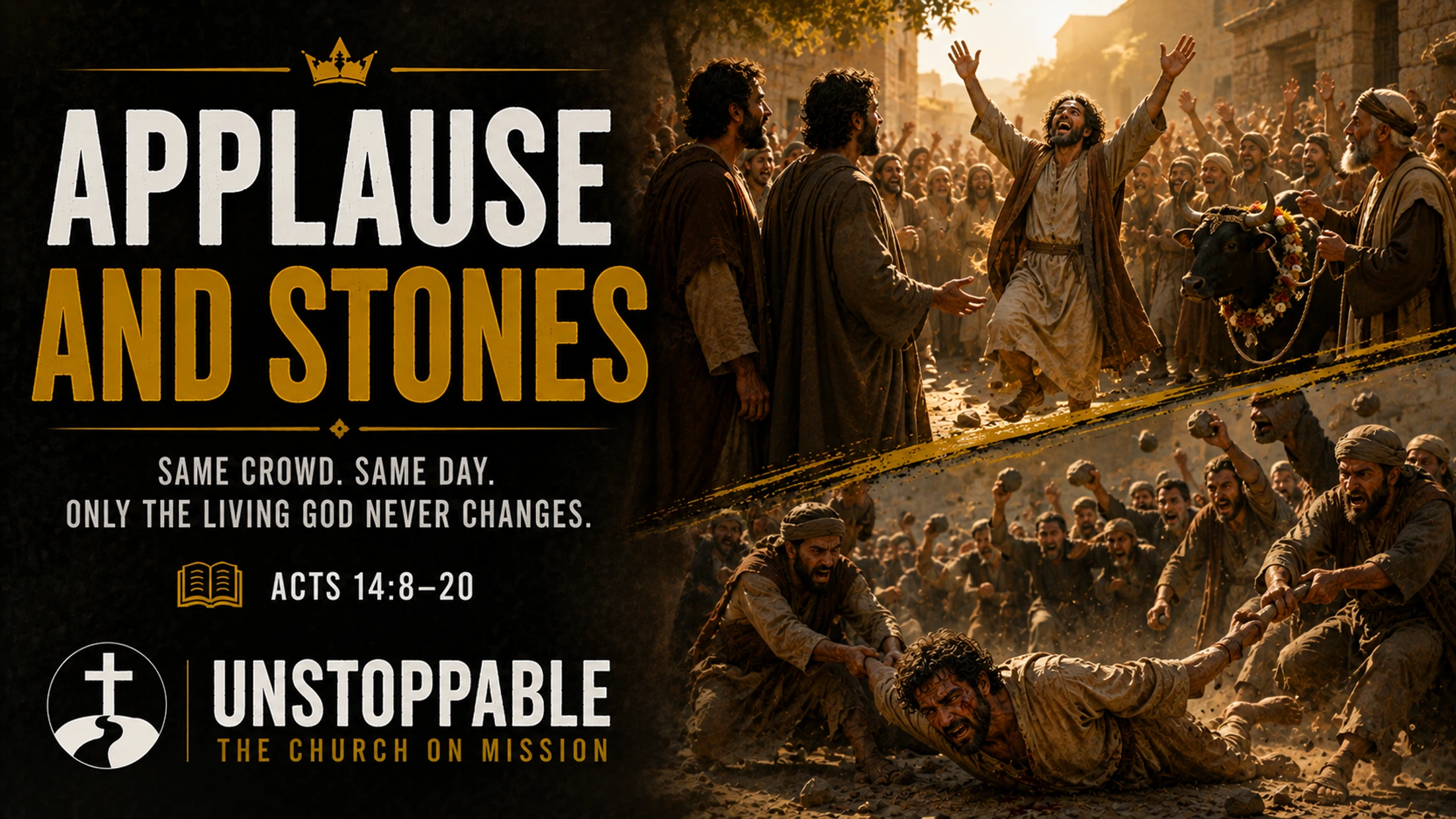
Sermon number thirty-eight opened with two scenes from the same city, the same street, and the same day, and Pastor Justin asked the church to hold both in view at once. In one scene a priest leads oxen and garlands up the road so a whole city can worship two men as gods. In the other scene, one of those same two men is dragged out of that town bleeding and left for dead. Nothing about the two men changed between those scenes, only the crowd did, and Pastor Justin built the entire message around one line meant to be carried out of the room: applause and stones came from the same crowd, only the living God never changed.
Turning to Acts 14:8-10, Paul and Barnabas arrive in Lystra, a small pagan town in the Roman province of Galatia with no synagogue and little Jewish population, and Paul notices a man crippled from birth listening intently to his preaching. Pastor Justin pointed out that Luke, a physician, closes off every possible exit in his description, this man had never walked a single day of his life. Paul tells him to stand, and he springs up and begins to leap, a direct echo of Isaiah 35:5-6's prophecy that the lame man would leap like a deer when God's salvation finally arrived, giving the first point of the sermon, that the living God still shows his power when he chooses to.
The crowd's reaction turns immediately, and Pastor Justin explained the cultural background that made it possible. Because they shouted in their local Lycaonian dialect rather than Greek, Paul and Barnabas had no idea what was being said until it was almost too late, and the region carried an old legend, recorded by the Roman poet Ovid, in which Zeus and Hermes once visited that exact area in disguise and destroyed everyone except the one couple who welcomed them. Pastor Justin noted that archaeologists have confirmed inscriptions near Lystra dedicated to Zeus and Hermes together, exactly the pair Luke names, evidence that this account is careful history rather than invention. The crowd's rush to worship Paul and Barnabas was not flattery, it was fear, a town determined not to repeat their ancestors' mistake.
That gave the second point of the message, that the living God will not share his glory. Paul and Barnabas tear their garments, the Jewish response to blasphemy, and rush into the crowd insisting they are only men, pointing instead to the living God who made heaven and earth and who had never left himself without witness, even in the rain and harvests these pagans had enjoyed their whole lives. Pastor Justin tied this straight to Romans 1:19-20, that God's eternal power and divine nature have been plainly perceived through creation, leaving people without excuse, and he was personally honest that in an earlier season of rapid youth ministry growth he had quietly let himself receive credit that belonged to God alone, a warning he did not soften for the congregation.
Just a few verses later, agitators from Antioch and Iconium arrive, persuade the same crowd, and stone Paul, dragging him out of the city certain he was dead. Pastor Justin lingered on how quickly the crowd turned, the same people who called Paul a god now leaving him for dead outside the gate, and used it to introduce the sermon's third point, that the living God holds his servants even when it feels like they are alone. God had just demonstrated the power to heal a lifelong cripple, meaning he clearly had the power to stop the stones, and he did not use it, a truth Pastor Justin said is often what scares people most about God, not that he cannot act but that he sometimes chooses not to.
He was clear that the healing was not God's approval and the stoning was not God's abandonment, God was equally good and equally present in both moments, and he anchored that conviction in 2 Corinthians 4:8-9, struck down but not destroyed. The disciples gather around Paul, he gets up, and he walks back into the very city that just tried to kill him before moving on to Derbe the next day, and Pastor Justin noted that it was in this same battered town, Lystra, that Paul would later find Timothy, the son in the faith who carried the gospel further than Paul ever could alone. The stones did not get the last word.
Pastor Justin closed with two very different mirrors held up to the congregation, one for anyone currently riding a season of applause who needs to hand the glory back to God before it costs them the way it nearly cost that Lystra crowd, and one for anyone who feels dragged out and left for dead, quietly assuming God has walked away. To both he said the same thing, God was good in the miracle and he is good in the dirt, and he is not done with either story yet.
This Week's Application
So this week, are you in a season of applause that has quietly started going to your head, or a season that feels like stones, and either way, have you let it change what you believe about who God is? We would love for you to join us this Sunday as we continue walking through Acts together.